Signed Tools
Mathematical certainty for agentic execution
Traditional AI security relies on probabilistic firewalls and brittle hooks to guess whether an agent is doing something malicious. But agents have access to your databases, APIs, and cloud infrastructure, which makes prompt injection a remote code execution vulnerability.
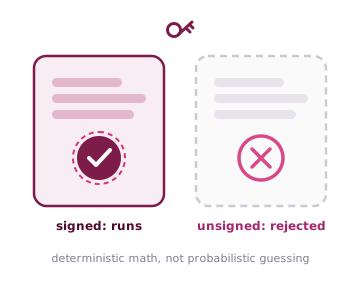
NuDay takes a different approach: mathematical certainty. We secure autonomous workflows by cryptographically signing the agent's tools, guardrails, and instructions.
If a command doesn't have the math to back it up, it simply doesn't run.
The risk
When prompt injection becomes command injection
When an agent reads a poisoned web page, untrusted PDF, or malicious email, an indirect prompt injection can overwrite its system prompt, hijacking the LLM and instructing it to run a backend tool, such as exporting a database or emailing a secure file to an external server.
Legacy systems try to stop this with brittle defenses:
Prompt firewalls
Scan text for malicious intent before the LLM reads it. Easily bypassed by encoding or novel attack phrasing.
Execution hooks
Use Python if/else statements to intercept the action. You are relying on software to police an unpredictable neural network.
If the attacker tricks the LLM or bypasses the filter, the rogue tool executes.
What we sign
What NuDay cryptographically signs
We physically separate the AI's reasoning (the LLM) from its execution environment using Public Key Infrastructure. Here is exactly what we sign and lock down:
Agent tools
What it is
The Python scripts, API calls, and functions your agent uses to interact with the world.
How it's protected
Every approved tool is hashed and signed with an enterprise private key. When the LLM requests a tool, the NuDay runtime verifies the cryptographic signature before execution.
The protection
Zero-click RCE and supply-chain attacks. If a hijacked prompt injects a rogue tool, or a compromised library alters the payload, the signature fails and execution is blocked instantly at runtime.
Behavioral guardrails
What it is
The hard boundary conditions that dictate what an agent cannot do, such as never expose PII, or never execute trades over $10k without human approval.
How it's protected
Guardrails are signed and immutably bound to the agent's core identity.
The protection
Instruction-override attacks. Because guardrails are signed at the infrastructure layer, not just typed into the system prompt, the LLM is physically incapable of overriding or forgetting its security boundaries.
Operational guidelines
What it is
The step-by-step standard operating procedures an agent must follow to complete a task compliantly.
How it's protected
Guidelines are version-controlled and signed.
The protection
Behavioral drift and hallucination. If the LLM hallucinates an unapproved step in a critical workflow, the runtime rejects it: the hallucinated path lacks the approved guideline's signature.
Agent skills and identity
What it is
The verified capabilities assigned to a specific agent, such as a read-only skill for the HR database.
How it's protected
Skills are cryptographically bound to the agent's OIDC identity token.
The protection
Lateral movement and privilege escalation. A compromised low-level agent cannot impersonate a high-level agent or grant itself new skills; the infrastructure demands cryptographic proof of the assignment.
Comparison
The state of agentic security
Many vendors claim to secure agents; almost all rely on probabilistic filtering or fragile code-level hooks. NuDay is the only platform enforcing deterministic, cryptographic execution.
| Security capability | NuDay | AI firewalls | Auth layers | Orchestrators |
|---|---|---|---|---|
| Core security mechanism | Cryptographic signatures (PKI) | Input/output prompt filtering | OAuth and identity mapping | Python if/else hooks |
| Protects against zero-click RCE | Yes (math-based blocking) | Partial (relies on detecting intent) | No (focuses on user auth) | No (developer-written filters) |
| Digitally signed guardrails | Yes (tamper-proof) | No (text-based wrappers) | N/A | No (system prompt only) |
| Execution determinism | 100% deterministic verification | Probabilistic (LLM detection) | Deterministic (OAuth scopes only) | Probabilistic (bypassable) |
| Supply-chain tool protection | Yes (verifies tool hash) | No | No | No |
| Best used for | Regulated enterprise deployments | General chatbot safety | Standardizing SaaS integrations | Rapid prototyping |
Secure the execution layer
Mathematical certainty for autonomous AI.
See how NuDay's cryptographic signatures give deterministic, tamper-proof control over what your agents can execute.